14/09/07 / Innforapenny II / Peter & Penny
INSTANBUL We have now arrýved ýn Istanbul ‘the gateway to the east’ as ýt ýs called ýn the travel books. Its the cýty of 10
LESVOS. After saying farewell to David and Susan (Stella) our cruising buddies, who are leaving the boat in Bodrum for the winter, we moved quickly
MARMARIS. On arrival in Kas, it didn’t take us long to get into the Turkish culture. We had dinner at the marina in a restaurant
ARRIVING IN TURKEY. We have finally arrived in Kas, Turkey, it is certainly good to be here, after two and half months in Greece we
RHODES After leaving Kos we headed to the volcanic island of Nisyros, which of course is famous for its semi active volcano. The sunken main
KOS Since Patmos we have visited Lipso, Leros, Kalymnos and now Kos, where Emily leaves us to head back to Verbier to continue her travels.
SANOS While in Mkyonos we took the ferry across to Delos, a small rocky island, which in ancient Greek times was one of the main
MYKONOS Over the last 10 days we have visited Sifnos, Serifos, Kythnos, Syros and now Mykonos – basically any island with an OS on the
THE MINOR CYCLADES From the unihabited southern beaches of Ios we moved the boat up Ormos Milopotamou a bay just below the main town of
SANTORINI Santorini, or Nisos Thira to call its correct name is a giant volcano shaped like a new moon encircling a rim of a crater
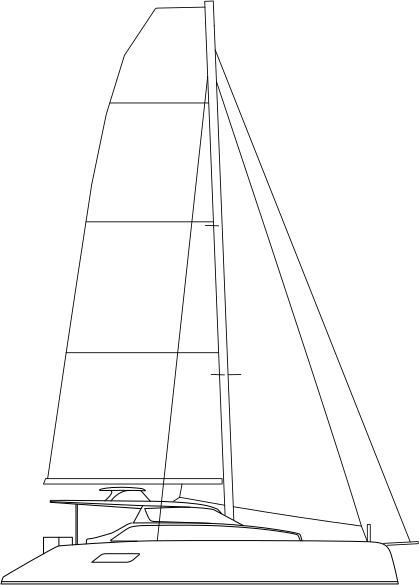
The Lightwave 46 has 800L of fresh water & 800L of diesel, in tanks that are built directly into the hull. High quality, purpose grade materials are used in this labour intensive construction method which guarantees an extremely high-quality product that will last for the lifetime of the boat. Dual freshwater pumps provided piece of mind through redundancy. A water transfer line is built into the system to allow water to travel between either tank. Fresh water vacuum toilets that use minimal fresh water (less than 400ml per flush) are a standard feature on the Lightwave 46, eliminating the stale saltwater smell that can encroach the cabin area. A saltwater system is also fitted to the vessel to allow an anchor wash, saltwater tap in the galley and hose in the cockpit.
The Lightwave 46 is designed for self-sufficient blue water
cruising. The vessel is supplied with a 12-volt DC and a 240-volt AC electrical
system. A 600Ah AGM battery system is offered on the vessel with an optional 660Ah
lithium-ion battery bank. There are various solar options producing up to 2000kw
of power. There is also the option to have a 4Kw AC diesel generator which is
coupled with the inverter to allow for a high output. All areas of the vessels
electrics are designed to be easily accessible and traceable with minimal
disruption to the boats systems. Electrical components on the Lightwave 46 are
carefully selected to ensure a minimum power consumption is achieved. Onboard systems
incorporate the latest in technology, allowing remote control and monitoring of
critical power systems, battery and charging status, tank levels, bilge pumps, aerial
and security CCTV as well as an array of other custom options.
The Lightwave 46 offers a very spacious area in the external engine rooms, to accommodate the standard 50hp engines & other engineering systems. All steering components as well as the optional generator are housed in the engine rooms, carefully positioned for ease of access for servicing and maintenance. The engine rooms are separated from the accommodation area with a bulkhead lined in sound dampening material to defer noise, heat and odour from entering the cabins. The engine rooms are also accessible from the inside of the boat if required.
Designed with the priority for the ultimate sailing experience, the deck layout and sailing systems are configured for ease of handling while shorthanded. The line system on the Lightwave 46 has been designed so all lines are organised and accessible from an area where the sails can be easily observed. Lines all lead to the cockpit and travel under serviceable fibreglass boards which not only keep the lines organised, but also remove possible tripping hazards. Hanging points are purposely provided creating a neat and organised place for line tails to be stored. Anderson winches and Ronstan deck gear are superiorly selected as standard equipment, with optional electric winches also available. A bridal main sheet system is cleverly applied to eliminate the safety concerns of a traveller car system traditionally used on catamarans.
Select your desired option below to share a direct link to this page